Showing posts with label Swallowcliffe Hall. Show all posts

Tuesday, 9 April 2013

Spirit of Place

'For one moment Swallowcliffe belonged to me. The lake, and the trees, and the sky above - even the house itself - were as much mine as they were anybody’s, because I had become a part of them and they were a part of me. Perhaps I would not vanish into thin air when the time came to go but leave something of myself behind. The next girl to sleep in that bed under the window might wake up one morning with a dream of me in her head, even though she would not know where it had come from, or quite what it was.'
From Polly's Story

Writing the Swallowcliffe Hall books has made me think about the impact a place can have on a person: the importance of the familiar sights we see every day, and the effect our surroundings can have on our state of mind. I've lived within the same four or five mile area of South London for nearly thirty years, with a couple of exciting years' time out in Johannesburg, and most of the time I walk about with my head in the air, thinking random thoughts instead of noticing or appreciating. So here is a tribute to a few of the things that I love about the place I live, in no particular order:

The flowerbed in the pavement outside the tapas bar, which has been painstakingly decorated with beer bottle tops. 

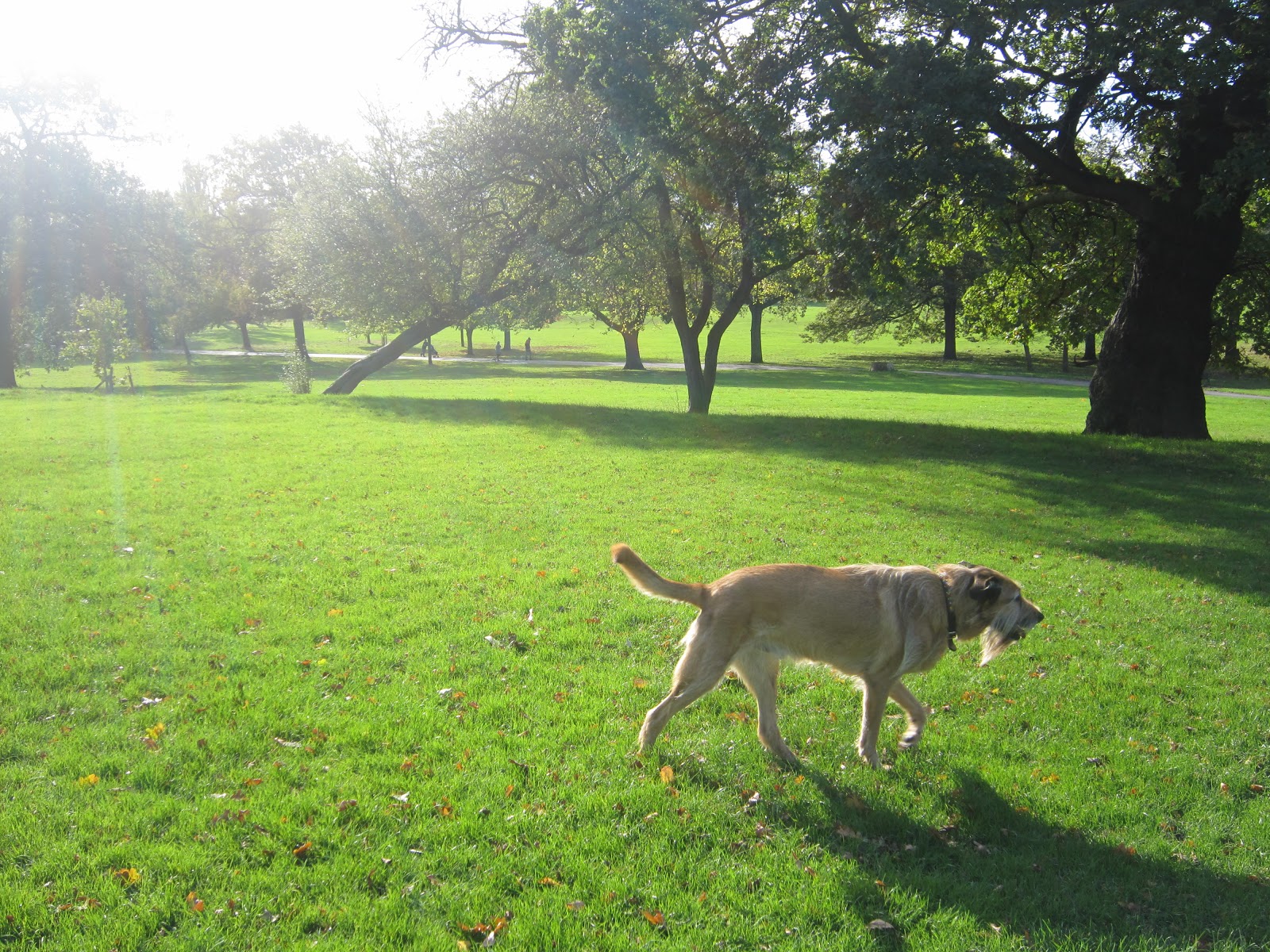
The trees in the park where I walk my dog, and the Georgian house at the top of the hill in the middle.

Bumping into people I know when nipping out to the shops or for a takeaway coffee.

The communal piano outside the station that's free for anyone to use.

The farmers' market on Sundays where you can buy meat, fish, organic veg, street food and all kinds of other interesting things. Last week there were petting lambs for spring! And rabbits!


The fact I can jump on a bus and be up at the South Bank in 30 minutes, or travel through London to St Pancras station in the north by train in the same amount of time (and maybe one day even hop on the Eurostar to Paris). London is my oyster...
The statue of John Betjeman at St Pancras station
 
I love the idea that your relationship with the world around you isn't just a one-way street: that you might have an impact on your environment as well as vice versa (something I was trying to explore in describing Polly's feelings when she knows she has to leave Swallowcliffe Hall). As Karen Blixen put it so poetically in Out of Africa: 

“If I know a song of Africa, of the giraffe and the African new moon lying on her back, of the ploughs in the fields and the sweaty faces of the coffee pickers, does Africa know a song of me? Will the air over the plain quiver with a colour that I have had on, or the children invent a game in which my name is, or the full moon throw a shadow over the gravel of the drive that was like me, or will the eagles of the Ngong Hills look out for me?”  


So what do you like about the place where you live?


Wednesday, 7 November 2012

Taking my mind - and the dog - for a walk

Brockwell Hall, the Georgian house in my local park
Just now I'm in the fallow period before starting to write my next Swallowcliffe Hall book: Lady Catherine's Story, in which Kate Vye takes over the running of the Hall when her husband Edward inherits the title on the death of his father. I find walking really productive when mulling over ideas - a combination of being out of the house in the fresh air and moving along to a rhythm, which seems to help my mind make connections as well.

I'm trying to imagine the dilemmas Kate would face, becoming mistress of a place like Swallowcliffe: her relationship with her fearsome mother-in-law, now exiled to the Dower House (maybe even refusing to go?), her dealings with the servants, who are possibly reluctant to take orders from a young American woman, the state of her marriage to a self-centred husband, used to getting his own way. Her money has saved the Hall but Edward considers it his, to use as he likes. There's also the fact that, after 6 or 7 years of marriage, they still have no children. And always in the background is Edward's charming brother, Rory. Has Kate married the wrong man? Does he still love her? Will she ever be happy with the life she has chosen?  I must think about her upbringing and her American family, too: her relationship with her parents, and with her cousin, Julia, who has married an Englishman and settled in the country. Because I've written about the Vye family in various periods of history (and in fact Kate's ultimate fate is described in Isobel's Story), there are various facts that constrain me - the trick is to throw in a few surprises along the way.


From the collection of Patrick Lynch
I'm looking forward to getting to know Kate. Up until now, we've only seen her through other people's eyes: Polly, the servant who maids for her when she first comes to stay at the Hall in 1890; Eugenie Vye, Kate's sister-in-law, who considers her attempts to look after the tenants on the estate a waste of time and money; Grace, Polly's daughter, who works at the house during the First World War and sees Lady Vye return from an ill-fated voyage aboard the Lusitania. Now I must try to catch Kate's voice and let her speak for herself. A cover image certainly helps. After a long search, I've found this photograph, which seems to me to represent Kate perfectly: her beauty, her enthusiasm, her energy. If you've read the books, does she look like Kate to you? I'd love to know!
So it will take a few more walks in the park before I've made a start at working it all out, before the characters begin to take shape. I don't want them to be cliches. The housekeeper, for example: we're all too familiar with a Mrs Danvers figure, hovering in the corridors full of malicious intent. Yet she can't be straightforwardly wonderful, either; there must be something or someone for Kate to rub up against (although Edward fills that role very well). I'm slightly concerned that her life may be too hard. If her marriage is unhappy, will the story be overly bleak? Somehow I must find a way of bringing joy into it.

I also need to think about where to begin. I wrote Eugenie's Story in the form of a diary, so that the reader discovered events pretty much the same time as she did. The first three stories were all told retrospectively, however, with a short coda at the end in the present tense - as Polly watches Kate leave the Hall to be married, as Grace and Philip declare their feelings for each other, and as Isobel describes what Swallowcliffe Hall has become in 1939.  I think I might go back to that format. I may even have Kate starting the story by remembering her wedding, describing it quite differently from Polly. And Polly must come back into the story - she and Kate have a special bond - so I shall have to work out what's happening to her in 1900.

So much to decide! Now where's the dog lead?        

Sunday, 28 October 2012

In Defence of Eugenie

Since releasing the latest volume in my Swallowcliffe Hall series, Eugenie's Story, about a month ago, I have come to realise that, while the book is selling well on both sides of the Atlantic, readers in the US don't actually seem to like Eugenie very much - or at least, not as much as Polly, Grace and Isobel. Poor Eugenie! I feel guilty. After all, I dreamed her up and now she's baring her soul in public, only to be condemned as a superficial airhead on Amazon.com.

It's true that Eugenie is superficial - at least to begin with. She is a product of her class and time, obsessed with herself, unaware of the feelings and lives of others, blind to the many injustices around her. I wanted to create a less straightforward narrator for this story, so that when she assessed a particular situation or judged a certain person, the reader might wonder what the real truth of the matter was. The gap between Eugenie's frequently high-flown language and the mundane reality of her life is sometimes touching, and often (to me, at least) comical. Upper-class girls of marriageable age in the Edwardian era were placed under such narrow constraints, their opportunities for expression so few, that many of them must have been frequently verging on the edge of hysteria, just like Eugenie. Her blunders and misapprehensions lead her into such trouble! Here she is, visiting a tenant cottage on the Swallowcliffe estate where the man of the house lies ill upstairs. She has brought some cast-off clothes with her:
 
I visit the Beamishes, with qualified success. Bearing the mourning gowns Miss Pratt has deemed beyond salvation, I knock on their front door for some minutes before Mrs Beamish eventually emerges, sleeves rolled up and hair falling down at the back. Apparently it’s wash day. Inside, the cottage is in chaos: there are children tumbling about all over the place and the baby is wailing. Mrs B takes me into the front room, where the furniture is now covered in dustsheets, but has to keep darting back to the kitchen as the copper’s boiling over. I’m not offered any refreshment, and when I unpack the parcel to show her the mourning gowns, she starts to cry. It soon becomes clear these are not tears of gratitude, as I initially assumed. One of the children sidles into the room to stare at me but runs away when I attempt to engage it in conversation. Feeling a little de trop, I take my leave as soon as decently possible, promising to return another day; Mrs Beamish is clearly relieved. Despite the best of intentions, I fear I lack the common touch.
 
Who else but Eugenie would consider mourning gowns a suitable gift when calling on the sick? I'm sorry, but she just makes me laugh. And that, I suppose, is the nub of the matter. If you don't find Eugenie at all funny, she must be hard to like. She's not particularly nice to her long-suffering maid, for example, constantly under-estimating and patronizing poor Bessie:
     
The transformation of Bessie has begun! Part of the problem, I realized with one of those flashes of inspiration that seem to come so regularly to me now, is her name. ‘Bessie’ sounds positively bovine, and her surname is Cheesman which presents further difficulties. I can’t go about calling ‘Cheesman!’ – it would be too ridiculous and has connotations with trade. I have decided to call her Beth, which is so much more refined. The name makes me think of Little Women, one of my favourite books, and while Bessie (as was) may never reach the fictional Beth’s heights of saintliness, she has now been leant a certain dignity.
 
If nothing in that passage makes you smile, at least inwardly, then Eugenie must seem very unlikeable. Books with unlikeable main characters can be hard work, yet they can also make a reader question the narrative and look for the truth between the lines. (Jane Harris's Gillespie and Me, for example, is quite brilliantly unsettling.) Granted, Eugenie is a snob, obsessed with herself and blind to the injustices around her, yet I've also tried to show that she's brave, passionate, kind-hearted in her own way, and funny. If anyone who's read the story would like to tell me what they think of her, I'd be fascinated.
    
PS - And look at her tiny waist! How could anyone be charitable in a corset laced so tightly?